
Table of Contents
- What Makes Rare K-Pop Collectibles Genuinely Valuable
- How to Spot Fake K-Pop Autographs Before You Pay
- Verifying K-Pop COA: What a Real Certificate Must Show
- BTS Signed Memorabilia: What Serious Collectors Look For
- BLACKPINK Rare Collectibles and Why They Hold Value
- Buying Rare K-Pop Collectibles Safely in 2026
- Frequently Asked Questions
Last Updated: 15 September 2026
What Makes Rare K-Pop Collectibles Genuinely Valuable
Rare kpop collectibles derive their value from three forces working together: scarcity, documented provenance and sustained demand. A signed album with no paper trail is a curiosity. The same album with a verified Certificate of Authenticity and a known signing event behind it becomes an investment. That distinction is the whole game, and it is where most buyers get caught out.
Scarcity alone proves nothing. Promotional albums pressed in tiny numbers turn up constantly on resale sites, often unsigned and often damaged. What separates a genuine rarity from a mass-produced item dressed up as one is evidence: where it came from, who handled it, and whether anyone independent has verified the signature. At Baderstreet, every piece we handle is judged on exactly those three questions before it reaches a listing.
Scarcity, Provenance and Demand
Scarcity is the easiest of the three to fake and the least reliable on its own. Provenance is harder to manufacture and far more valuable.
Provenance means the documented history of an item: the event where it was signed, the chain of ownership, photographs, receipts, or a signed statement from the original recipient. Demand, meanwhile, is what turns a scarce object into a liquid asset. Groups with large, active, international fanbases sustain secondary-market prices because there is always another buyer.
When all three line up, value holds. When any one is missing, you are speculating, not collecting.
How to Spot Fake K-Pop Autographs Before You Pay
Learning how to spot fake K-pop autographs comes down to three physical checks: ink behaviour, pen pressure and signing style. Forgery is rarely perfect, and the flaws show up at close range.
Ink is the first tell. Genuine signatures are usually written in one continuous motion with consistent ink flow (An examination of handwritten signatures forged using photosensitive signature stamp). A traced signature often shows hesitation: tiny stops, uneven thickness, or ink pooling where the pen paused.
Pressure is the second. Hand-signed items carry a slight indentation you can often feel by running a fingertip lightly across the reverse of the paper or card (An examination of handwritten signatures forged using photosensitive signature stamp). Printed or photocopied signatures sit flat on the surface.
The third check is style. Idols sign in consistent, practised patterns, but no two genuine signatures are identical. Perfectly repeated duplicates are a warning sign, not a selling point.
Verifying K-Pop COA: What a Real Certificate Must Show
Verifying a K-pop COA means checking that the certificate identifies the item, the signer, the signing context and the issuing party, and that it cannot be swapped between items. A certificate that only says "authentic" in bold type is decoration, not documentation.
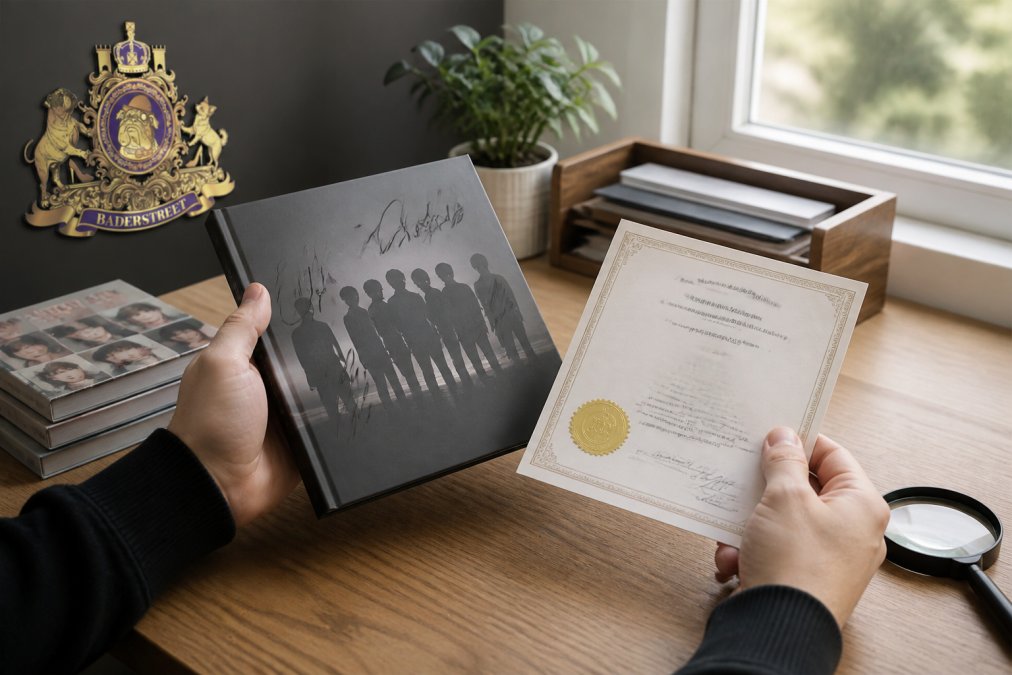
A genuine certificate should carry the following, at minimum:
- The full name of the group and the specific member who signed
- A description of the item, including format and edition
- A unique reference or serial number
- The date or event context of the signing, where known
- The name of the issuing business and a way to contact them
- Security features such as a hologram, embossing or a matching seal
If a seller cannot show you these details before purchase, walk away. A physical COA that matches the item in front of you is the single strongest protection a collector has.
BTS Signed Memorabilia: What Serious Collectors Look For
BTS signed memorabilia commands attention because the group's fanbase is global, long-standing and willing to hold rather than flip. That stability is exactly what serious collectors want.
The pieces that hold value tend to share features: a clear link to a specific era or release, a signature from a named member, and a certificate that ties the two together. A BTS Album BUTTER DELUXE - LIMITED EDITION AUTOGRAPHED is a good example of the type collectors prioritise, because the edition itself is limited and the autograph is documented rather than claimed.

Smaller format items matter too. A BTS V Kim Tae-hyung Autograph or a BTS JHope Autograph appeals to collectors who want a single member's signature rather than a full-group piece. Art boards, such as this BTS JHope Shikishi Art Board Autograph, sit in a different bracket again, since the format is unusual and harder to replace.


What most guides miss is that member-specific demand can outpace group demand. A collector building around one idol will often pay more for that idol's signature than for a group piece signed by everyone.
BLACKPINK Rare Collectibles and Why They Hold Value
BLACKPINK rare collectibles hold value for a structural reason: the group releases infrequently, tours in bursts, and maintains a large international following between comebacks. Limited supply plus persistent demand is the classic recipe for price stability.
The items that perform best are those tied to a defined moment: a tour, a debut anniversary, a limited pressing. Signed items from those windows are finite, and once they settle into private collections they rarely return to the market.
Condition matters more here than in almost any other category. A creased photocard or a scuffed album cover can wipe out a large share of an item's value, because collectors are buying the object as much as the signature (ifcc.org). Store signed pieces flat, away from direct sunlight, and handle them with clean, dry hands or cotton gloves. If you are buying to hold, buy the best condition you can find rather than the cheapest.
Buying Rare K-Pop Collectibles Safely in 2026
Buying rare kpop collectibles safely comes down to four habits: buy from sellers who document authenticity, pay through protected channels, understand the shipping and customs position before you commit, and store what you buy properly.
Start with the seller. A business that issues a physical COA, publishes verifiable contact details and can answer specific questions about an item's history is a far safer counterparty than an anonymous listing. Baderstreet's record of 100% positive feedback on eBay reflects the same standard we apply to every direct sale: if we cannot document it, we do not sell it.
Then look at the transaction itself. Use payment methods with buyer protection, keep the listing details and correspondence, and ask for additional photographs of the signature and certificate before paying.
Shipping, Customs and Storage
Shipping is where otherwise careful purchases go wrong. Signed paper goods are vulnerable to moisture, bending and heat, so they need rigid packaging and a tracked, insured service rather than a padded envelope.
Customs is the other variable. Import duties and handling fees are set by the destination country, and the threshold varies, so check your own country's rules before you buy rather than after. A seller who ships internationally with insurance and tracking removes most of the risk, but the duty position is always the buyer's to confirm.
For storage, keep items flat, cool, dry and out of sunlight. Avoid attic and basement storage entirely: both swing in temperature and humidity, and both will eventually damage paper.
| Stage | What to Check | Why It Matters |
|---|---|---|
| Before buying | Seller history, COA details, item photographs | Filters out undocumented items |
| At payment | Buyer protection, saved listing and messages | Gives you recourse if the item is wrong |
| Before shipping | Insurance, tracking, rigid packaging | Protects a fragile, irreplaceable item |
| On arrival | Duties and fees paid, condition checked | Avoids surprise costs and disputes |
| Long term | Flat, cool, dark, dry storage | Preserves condition and resale value |
The challenge with rare kpop collectibles is that the market rewards patience and punishes impulse, and the difference between a sound purchase and an expensive mistake usually comes down to paperwork. Baderstreet exists to remove that uncertainty: every premium piece we offer arrives with a physical Certificate of Authenticity, is backed by our flawless 100% positive eBay seller reputation, and is dispatched by fully insured worldwide express shipping so that irreplaceable items reach you in the condition they left us. Get started with Baderstreet and build a collection you can verify, not just admire.
Frequently Asked Questions
How can I verify the authenticity of a signed K-pop album?
Start with the signature itself: compare ink colour, pen pressure and stroke order against known examples from the same era. Then check the paperwork. A genuine seller provides a physical Certificate of Authenticity naming the group, member and signing event, plus a traceable provenance record. Ask for close-up photographs of the signature and the certificate before buying. If the seller cannot supply either, treat the item as unverified and walk away, however good the price looks.
Are Certificates of Authenticity reliable for K-pop autographs?
A COA is only as trustworthy as the seller behind it. Look for a physical certificate rather than a digital file, a unique reference number, the signing date and location, and a seller with a public track record. Baderstreet, for example, issues a physical COA with every hand-signed piece and backs it with 100% positive eBay feedback, which gives buyers an independent record to check. A certificate from an anonymous marketplace listing proves very little.
What makes a K-pop collectible rare and valuable?
Three things drive value: limited supply, verified provenance and sustained demand. Promotional albums signed at a specific event, first-press editions and items tied to a particular tour are produced in small numbers and cannot be reordered. When that scarcity is paired with a documented COA and a group with a large, loyal fanbase such as BTS or BLACKPINK, prices hold. Items without proof of origin rarely appreciate, no matter how scarce they appear.
Where is the safest place to buy rare K-pop memorabilia online?
Buy from sellers who combine three things: a physical COA, insured express shipping and a verifiable feedback history. Insured courier delivery matters because signed albums and art boards are irreplaceable if lost or damaged in transit. Before ordering, ask how customs fees are handled so there are no surprise charges on arrival. A specialist boutique that documents provenance and ships with UPS or DHL Express removes most of the risk that comes with general marketplace listings.
0 Kommentare